Good product leadership makes room for good decisions
Product management decision making needs context, trust and trade-offs. My takeaways on leadership and AI from Product & Data Unfiltered.

Adapted from my LinkedIn post originally shared on 2026-09-20. This journal version was prepared on 27 November 2026.
I spent a Friday at Product & Data Unfiltered by Field Nation at Amari Dhaka and came back with a thought I did not quite expect about product management decision making.
Field Nation and Startise have different products, markets, customers and business models. Yet across the sessions on product, design, data, engineering and AI, the conversations felt familiar. The product leadership questions underneath them were ones we face in our own work too.
Give people the context to decide
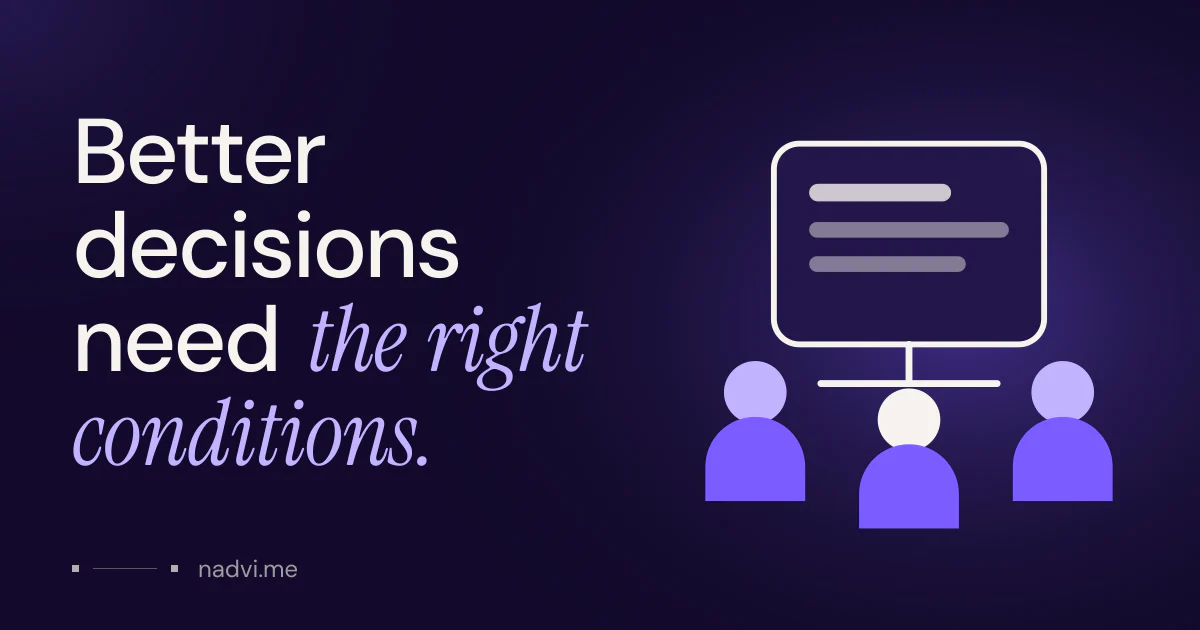
Shane Kinder’s session gave me another way to think about process. The process around a team should help people make better decisions and create better outcomes. What stayed with me was the emphasis on context, trust, ownership and accountability.
It made me think about how much of product leadership is setting up those conditions, rather than trying to make every decision yourself. A team cannot own a decision well if it only receives the answer and never gets to understand the problem or the trade-offs.
When feedback and data point in different directions
I asked Lisa S. what happens when customer feedback, product data and business priorities point toward different problems. My takeaway was that there is not always one formula. The answer depends on the customer, how many people face the problem, the value of that segment, and the context around it.
That does not mean whichever opinion is loudest should win. It means making the disagreement visible and asking what evidence would change the decision. I also liked her practical approach to experimentation: let the product fail, learn from it, and use that learning to make it better.
An experiment is only useful if the team can see what happened and use it in the next decision. A failed idea can teach us something; a failure we never examine is simply a missed opportunity.
AI makes execution faster. The choice still needs a person.
At Startise we use AI to build, test, automate repetitive work and move faster. Some work that once took months can sometimes be done in weeks. The difficult part is still understanding the customer, choosing a worthwhile problem, making trade-offs and deciding what not to build.
The afternoon also gave me the chance to meet my mentor Shadab Shayeree Ahmed in person, along with product and design people, seniors and juniors. The sessions were useful, but so were the conversations between them.
Different companies and different customers can arrive at surprisingly similar questions. I left with a reminder to make space for people to ask those questions and own the answers.
A question to take back to the team
When a decision is difficult, I find it useful to put the competing signals in the same conversation. What are customers experiencing? What does the data show, and what does it leave out? What does the business need, and what would we give up by choosing one option over another?
Those questions will not produce a perfect answer every time. They give the people making the decision a shared view of the trade-off and a better starting point for learning from it. I wrote more about interpreting support signals in how I use support data for a roadmap.
Questions, answered.
Put the signals and their limits side by side. Consider who is affected, how many people face the problem, the business context and what evidence could change the decision.
Leaders can give teams context, trust, clear ownership and accountability so the people closest to the problem can make informed decisions.
AI can help teams research, test and draft, but a person still needs to assess the customer problem, the evidence and the trade-offs and own the decision.