I got tired of explaining the same context to every AI tool
Portable AI memory started with a simple frustration: explaining the same context to different tools. Here is the approach I chose and why.

Adapted from my LinkedIn post originally shared on 2026-08-22. This journal version was prepared on 27 November 2026.
Every AI tool I use remembers me. None of them remembers each other. That is what led me to build portable AI memory.
One lives in my editor, another on my phone, and another is useful for a different kind of work. I found myself acting as the middleman, explaining in the evening what I had already explained to another tool that morning.
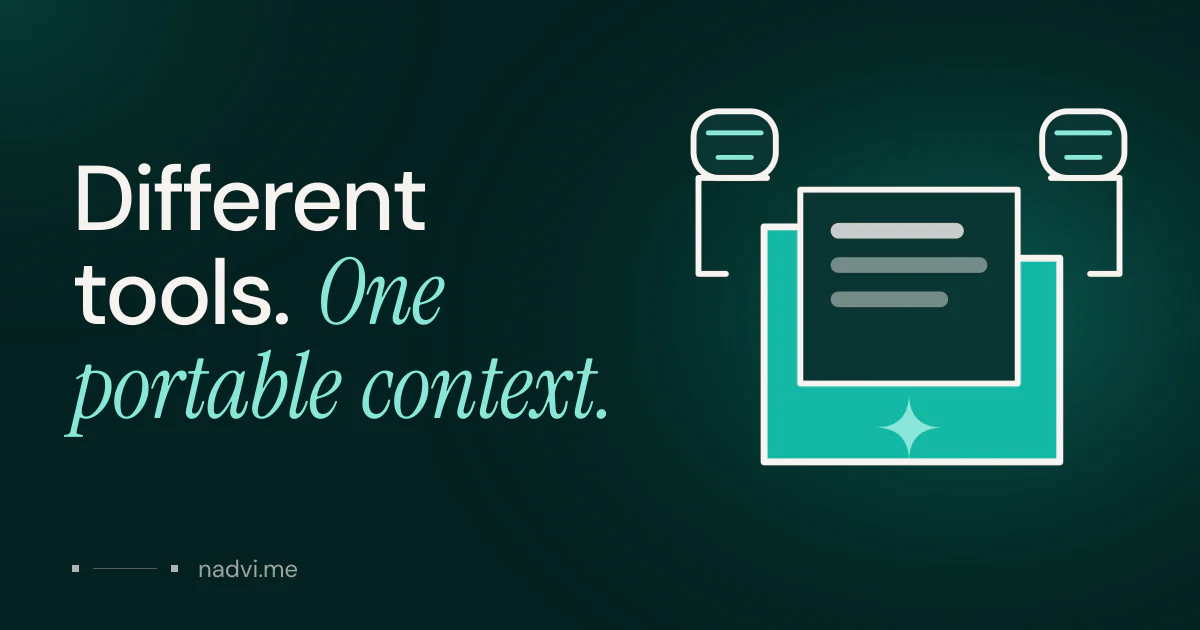
That frustration led me to think about portable AI memory: context that can move with a person instead of being tied to one assistant or one device.
I wanted the context to be mine
I looked at existing approaches. Many involved running a server or signing up for another service. Those can be useful solutions, but I wanted something I could understand and carry with me without making another product the only home for the information.
I chose plain Markdown files in a private Git repository. The format is ordinary text, so I can read and edit it without an AI tool. Git gives me a history of changes and a way to move a copy between environments. It does not make the information magically safe or available in every situation: access, backups, privacy, and conflicts still need attention.
Explain the rules in a file too
The part that surprised me was how little tool-specific setup was needed for the idea itself. I wrote a plain-language introduction explaining what the memory was and the rules for using it. When I gave another assistant access and asked it to read that introduction, it could follow the same approach.
That does not mean every tool has identical access or will always follow instructions perfectly. The point is that the structure is understandable outside one particular assistant. A person can inspect it and decide what belongs there.
A small idea with a practical limit
The useful distinction for me is between an assistant’s built-in memory and a set of notes I control. The notes can preserve context across tools, but I still need to decide what to save, who can access it, and whether it is appropriate to share with a service.
I also created a separate public template for people interested in trying the idea. The public example is separate from my private notes. There is no need to copy anyone’s personal information to learn from the approach.
The goal was not to make AI remember everything. It was to stop losing useful context whenever I changed the tool I was working in.
What makes the approach portable
The notes use a format a person can read and edit, and the instructions describe how to use them in plain language. That makes it easier to introduce another compatible tool to the same context. Portability is still practical work: you need a copy you can access, a way to manage conflicting changes, and a decision about which information each tool should be allowed to see.
I keep the public example separate from personal notes. Before connecting any service, check what it can read, write or retain, and only share information you are comfortable giving that service.
I wrote separately about the decisions and checks I keep in my own AI workflow for product work.
Questions, answered.
It is an approach to keeping useful context in a form that can be used across compatible tools rather than living only inside one assistant.
No. A tool needs appropriate access and instructions, and its behaviour can vary. A person still needs to review what is stored and how it is used.
Check the service’s access, retention and sharing policies, and keep sensitive information out unless you are comfortable with that access.